

Calcium gets most of the attention when people think about bone health. But calcium does not work alone.
The body depends on a network of nutrients to absorb calcium, maintain normal bones, and regulate the proteins involved in bone metabolism. Two important nutrients in that system are vitamin D3 and vitamin K2.
Vitamin D3 is best known for supporting calcium absorption. Vitamin K2 belongs to the vitamin K family and participates in the activation of vitamin K-dependent proteins, including osteocalcin, a protein involved in bone metabolism.
This biological relationship is why vitamin D3 and K2 supplements are increasingly paired together.
But some of the claims surrounding D3 and K2 go considerably further than the science. If you've been researching this pairing, you may be wondering:
● Does vitamin D3 really strengthen bones?
● Does vitamin K2 “send calcium to your bones”?
● Is K2 the same thing as MK-7?
● How much vitamin D3 do adults need?
● Is 2,000 IU a high dose?
● Does everyone taking vitamin D need vitamin K2?
This evidence-based guide separates established nutrition science from oversimplified supplement marketing.
This evidence-based guide separates established nutrition science from oversimplified supplement marketing.

What Is Vitamin D3?
Vitamin D is a fat-soluble vitamin that also functions as a hormone precursor in the body.
There are two major forms commonly encountered in foods and dietary supplements:
Vitamin D2 (ergocalciferol) and vitamin D3 (cholecalciferol).
Vitamin D3 is also the form the human body produces when skin is exposed to sufficient ultraviolet B (UVB) radiation from sunlight.
Whether vitamin D comes from sunlight, food, or supplements, it must undergo metabolic conversion before becoming biologically active.
One of vitamin D's most established physiological roles involves calcium and phosphorus metabolism.
What Does Vitamin D3 Do in the Body?
Vitamin D supports several normal physiological processes, including calcium absorption, bone mineralization, muscle function, and normal immune function.
Its relationship with calcium is particularly important.
The skeleton contains the overwhelming majority of the body's calcium. Maintaining that skeletal structure requires not only consuming calcium but also being able to absorb and regulate it.
Vitamin D helps make that possible.
The NIH Office of Dietary Supplements describes vitamin D as promoting calcium absorption in the gut and maintaining adequate calcium and phosphate concentrations needed for normal bone mineralization.
That does not mean vitamin D alone “builds bones.” Bone health is influenced by calcium, phosphorus, protein, vitamin D, vitamin K, physical activity, hormones, age, genetics, and overall health.
Nutrition works as a system.
How Does Vitamin D Help With Calcium Absorption?
When vitamin D status is adequate, active vitamin D helps regulate proteins involved in transporting calcium across the intestinal wall.
In simpler terms:
You can consume calcium, but the body still needs an effective mechanism for absorbing it. Vitamin D is an important part of that mechanism.
This is why vitamin D and calcium are so frequently discussed together.
However, calcium absorption is not unlimited. The body regulates it according to physiological needs, age, dietary intake, vitamin D status, and other factors. Calcium absorption also tends to decrease as calcium intake rises.
More calcium plus more vitamin D therefore does not automatically equal stronger bones.
What Is Vitamin K2?
Vitamin K is another fat-soluble vitamin, but its physiological role is different from vitamin D.
The vitamin K family includes vitamin K1 (phylloquinone) and a group of compounds known collectively as vitamin K2 (menaquinones).
Vitamin K acts as a cofactor for an enzyme needed to activate, or carboxylate, certain vitamin K-dependent proteins.
These proteins participate in several physiological processes.
Vitamin K is particularly well established for its role in normal blood clotting, but vitamin K-dependent proteins are also present in bone and other tissues.
One of the most frequently discussed in bone research is osteocalcin.
What Is Osteocalcin?
Osteocalcin is a protein produced primarily by bone-forming cells called osteoblasts.
Vitamin K is required for the carboxylation of osteocalcin.
You can think of carboxylation as a biochemical activation step. Without sufficient vitamin K, a greater proportion of circulating osteocalcin can remain undercarboxylated.
Researchers therefore sometimes measure undercarboxylated osteocalcin (ucOC) as a biomarker when studying vitamin K and bone metabolism.
This is where the popular relationship between vitamin K2 and calcium originates.
However, the marketing phrase that K2 simply “directs calcium into your bones and away from your arteries” is an oversimplification.
The biology is more complicated.
A more scientifically accurate statement is:
Vitamin K supports the activation of vitamin K-dependent proteins, including osteocalcin, that participate in normal bone metabolism.

Why Are Vitamin D3 and K2 Taken Together?
Vitamin D3 and vitamin K2 participate in different aspects of calcium and bone physiology.
Vitamin D supports calcium absorption and helps maintain appropriate calcium and phosphorus availability.
Vitamin K supports the activation of vitamin K-dependent proteins involved in processes that include bone metabolism.
That gives the two nutrients biologically complementary roles.
Researchers have consequently investigated whether combining vitamin D and vitamin K could influence markers of bone health.
A 2020 systematic review and meta-analysis evaluated eight randomized controlled trials involving 971 participants. The researchers reported that combined vitamin D and vitamin K supplementation was associated with increased total bone mineral density and decreased undercarboxylated osteocalcin. Subgroup analyses suggested favorable results when vitamin K2 was used.
Those findings are interesting, but they should not be interpreted as proof that every D3 + K2 supplement prevents fractures or increases bone density in every person.
Clinical outcomes depend on factors such as baseline nutrient status, age, health, dose, duration, diet, and study population.
Does Vitamin D3 Build Stronger Bones?
Vitamin D is essential for normal bone physiology.
That does not mean taking progressively more vitamin D continuously makes bones stronger.
This distinction is important.
A major 2018 systematic review and meta-analysis examined 81 randomized controlled trials involving 53,537 participants. Across the populations studied, vitamin D supplementation did not meaningfully reduce total fractures or falls and did not produce clinically meaningful improvements in bone mineral density.
More recent large trials have reinforced the importance of baseline status and population. For example, research reviewing the VITAL and DO-HEALTH trials found that 2,000 IU of vitamin D per day did not reduce fractures, improve bone density, or improve several other musculoskeletal outcomes in generally healthy adults who were not selected for vitamin D deficiency.
This does not mean vitamin D is unimportant.
It means:
An essential nutrient and a beneficial supplement intervention are not automatically the same thing.
Someone who is deficient has a different nutritional situation from someone who already has adequate vitamin D status.
What Does Research Say About Vitamin K and Bone Health?
Vitamin K's involvement in bone biology is well established, but clinical outcomes from supplementation are less certain.
A 2019 systematic review examined 36 randomized controlled trials of oral vitamin K supplementation and bone mineral density or fractures.
Some analyses suggested possible benefits. However, when researchers restricted analyses to studies with lower risk of bias, several apparent effects became smaller or statistically uncertain. The authors concluded that the evidence was insufficient to confirm a fracture-reduction benefit.
This distinction matters.
There is a difference between:
“Vitamin K participates in normal bone metabolism.”
and:
“Taking K2 has been proven to prevent fractures.”
The first is supported by established physiology.
The second goes beyond what current evidence can reliably establish for the general population.
Vitamin K1 vs K2: What's the Difference?
Vitamin K1 and K2 belong to the same vitamin family, but they are chemically different.
Vitamin K1, or phylloquinone, is abundant in leafy green vegetables such as spinach, kale, collard greens, and broccoli.
Vitamin K2 refers to a family of menaquinones.
Different menaquinones are identified by names such as MK-4, MK-7, MK-8, and MK-9.
The “MK” stands for menaquinone, while the number reflects structural differences in the molecule's side chain.
These differences can affect how individual forms behave in the body.
MK-4 vs MK-7: Are They the Same?
No.
Both are forms of vitamin K2, but MK-4 and MK-7 are chemically distinct menaquinones.
MK-4 occurs in certain animal-derived foods and can also be formed in tissues from other forms of vitamin K.
MK-7 is particularly associated with fermented foods such as natto and has a relatively long circulating half-life.
This distinction is important when reading supplement labels.
A product that says “vitamin K2” or “menaquinone” should not automatically be assumed to contain MK-7 unless the specific form is identified.
How D3 and K2 Fit Into Calcium Physiology
The easiest way to understand the relationship is to separate their functions.
Vitamin D3 → supports vitamin D status → supports intestinal calcium absorption and normal bone mineralization.
Vitamin K2 → supplies vitamin K → supports activation of vitamin K-dependent proteins, including osteocalcin.
These pathways interact within a much larger nutritional system.
Calcium itself remains essential. So do adequate protein, phosphorus, magnesium, physical activity, and many other biological factors.
This is why the most scientifically accurate view of D3 + K2 is not:
“D3 absorbs calcium and K2 sends it to your bones.”
It is:
“Vitamin D and vitamin K perform different but complementary physiological roles related to calcium and bone metabolism.”

How Much Vitamin D Do Adults Need?
Vitamin D requirements vary by age.
According to the U.S. National Academies recommendations used by the NIH Office of Dietary Supplements, the recommended dietary allowance for most adults ages 19–70 is 600 IU (15 mcg) per day.
For adults over 70, the recommendation rises to 800 IU (20 mcg) per day.
Those numbers represent recommended total daily intake—not a universal prescription for how much supplemental vitamin D every person should take.
Someone's need for supplementation can depend on diet, sun exposure, age, skin pigmentation, geographic factors, absorption, health conditions, and existing vitamin D status.
What Does 2,000 IU of Vitamin D3 Mean?
Vitamin D labels can be confusing because the amount may be expressed in either International Units (IU) or micrograms (mcg).
For vitamin D:
1 mcg = 40 IU
Therefore:
2,000 IU vitamin D3 = 50 mcg vitamin D3.
This conversion is useful when comparing dietary supplements.
For context, the tolerable upper intake level established for adults is 4,000 IU (100 mcg) per day from all sources, although individual medical circumstances can differ.
An upper limit should not be confused with a recommended target.
How Is Vitamin D Status Measured?
Vitamin D intake and vitamin D status are not the same thing.
The primary laboratory measurement used to evaluate vitamin D status is blood 25-hydroxyvitamin D, commonly abbreviated 25(OH)D.
Testing can be useful in situations where a healthcare professional suspects deficiency or where medical circumstances make vitamin D status particularly relevant.
This is more informative than assuming everyone needs the same supplemental dose.
Can You Take Too Much Vitamin D?
Yes.
Vitamin D is fat-soluble, and excessive supplementation can cause toxicity.
Vitamin D toxicity can lead to excessive calcium in the blood, known as hypercalcemia, and excessive urinary calcium. In severe cases, complications can include kidney problems, soft-tissue calcification, cardiac arrhythmias, and other serious effects.
Vitamin D toxicity is generally associated with excessive supplemental intake rather than ordinary food consumption or normal sun exposure.
The lesson is straightforward:
More vitamin D is not automatically better.
How Much Vitamin K Do Adults Need?
U.S. recommendations for vitamin K are expressed as an Adequate Intake (AI) rather than an RDA.
For adults, the AI is:
120 mcg per day for men
90 mcg per day for women
These recommendations refer to total vitamin K intake and are not specific recommendations for K2 supplementation.
That distinction is important because supplement labels frequently present K2 amounts without explaining that established dietary recommendations encompass vitamin K generally.
What Foods Contain Vitamin D3?
Vitamin D occurs naturally in relatively few foods.
Useful dietary sources include fatty fish such as salmon, trout, tuna, and mackerel. Smaller amounts can occur in egg yolks, liver, and some other animal foods.
Many people also obtain vitamin D from fortified foods, which can include milk, plant-based beverages, breakfast cereals, and other products depending on the country and manufacturer.
Sunlight can also contribute to vitamin D status because UVB radiation triggers vitamin D3 synthesis in skin.
However, sun exposure is highly variable and excessive UV exposure carries established skin-health risks, so deliberately increasing unprotected sun exposure is not a risk-free vitamin D strategy.
What Foods Contain Vitamin K2?
Vitamin K2 occurs in certain fermented and animal-derived foods.
Natto, a traditional Japanese fermented soybean food, is particularly rich in MK-7.
Other menaquinones can occur in fermented cheeses and some animal foods.
Vitamin K1, meanwhile, is abundant in green leafy vegetables.
A balanced diet can therefore provide multiple forms of vitamin K.
Should Vitamin D3 Be Taken With Food?
Vitamin D is a fat-soluble vitamin.
Its absorption occurs alongside dietary fats, which is why taking vitamin D with a meal containing some fat can be a practical approach.
However, people do not need to turn vitamin supplementation into an overly complicated timing ritual.
Consistency, appropriate intake, overall diet, and individual nutritional status generally matter more than chasing a supposedly perfect minute of the day.
Do You Have to Take K2 With Vitamin D3?
No universal nutritional rule says that every dose of vitamin D3 must always be accompanied by vitamin K2.
The two nutrients have complementary physiological roles, which provides a rational basis for combining them.
That is different from demonstrating that vitamin D without K2 is inherently unsafe.
People should be skeptical of claims suggesting that taking vitamin D without K2 automatically causes calcium to accumulate in arteries.
The human regulation of calcium is far more complex than that claim suggests.
Can Vitamin K2 Interact With Medications?
Yes, and this is one of the most important safety considerations surrounding vitamin K supplements.
Vitamin K can interact significantly with vitamin K-antagonist anticoagulants such as warfarin.
People taking warfarin are generally advised to maintain a consistent vitamin K intake because major changes can alter the medication's anticoagulant effect.
Anyone taking warfarin or another medication affected by vitamin K should speak with the clinician managing that medication before starting, stopping, or substantially changing a vitamin K supplement.
D3 + K2 Oral Strips vs Capsules, Gummies and Drops
Vitamin D and vitamin K supplements are available in several delivery formats.
Capsules and tablets are widely available and make precise dosing straightforward, although some people dislike swallowing pills.
Drops can offer flexible serving sizes but require measuring.
Gummies can make supplementation more approachable but may include additional sweeteners and ingredients.
Quick-dissolve oral strips prioritize portability and convenience. A strip can be placed on the tongue and allowed to dissolve without requiring pills, mixing, or a glass of water.
That convenience can make a daily routine easier for some people.
However, the delivery format should not be confused with proven superiority.
Without formulation-specific comparative pharmacokinetic research, it would be inappropriate to assume that an oral strip automatically provides better absorption than a capsule, gummy, or liquid.

What's Inside One ALBA D3 + K2 Strip?
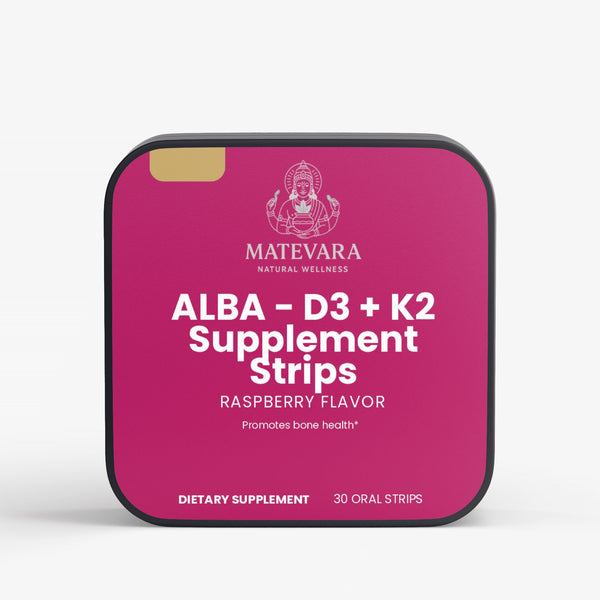
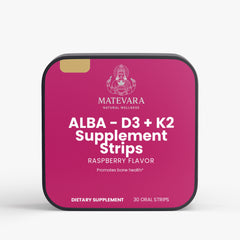
For people who prefer a quick-dissolve format, Matevara ALBA D3 + K2 Supplement Strips combine both nutrients in a single raspberry-flavored oral strip.
Each strip provides:
| Nutrient | Amount per strip |
|---|---|
| Vitamin D3 (Cholecalciferol) | 2,000 IU / 50 mcg |
| Vitamin K2 (Menaquinone) | 120 mcg |
The formula uses vitamin D3 as cholecalciferol and vitamin K2 as menaquinone.
The quick-dissolve strip format is designed around convenience: one strip, no pill to swallow, no powder to mix, and no water required.
It is important, however, to distinguish the convenience of the delivery system from the biological effects of the nutrients themselves.
The evidence discussed throughout this guide concerns vitamin D and vitamin K broadly. It should not be interpreted as proof that this specific product prevents osteoporosis, fractures, cardiovascular disease, or any other medical condition.
Who Should Pay Particular Attention to Vitamin D?
Vitamin D status can be influenced by many factors.
Older adults may produce less vitamin D in the skin. People with limited sun exposure may have less opportunity for cutaneous vitamin D production. Certain gastrointestinal conditions can affect absorption, while some medications and medical conditions can alter vitamin D metabolism.
People with concerns about deficiency should discuss their individual circumstances with a qualified healthcare professional.
A blood test, when medically appropriate, provides considerably more useful information than simply assuming symptoms indicate vitamin D deficiency.
What Matters Most for Long-Term Bone Health?
Bone health is not built by one vitamin.
A comprehensive approach includes adequate calcium, protein, vitamin D, vitamin K, and other nutrients, along with regular physical activity.
Weight-bearing and resistance exercise are particularly relevant because bone responds to mechanical loading.
Lifestyle factors also matter. Smoking, excessive alcohol consumption, aging, hormonal changes, certain medications, and medical conditions can all influence bone health.
Supplements can complement these fundamentals.
They do not replace them.
The Bottom Line
Vitamin D3 and vitamin K2 are distinct nutrients with different but complementary roles in human physiology.
Vitamin D supports calcium absorption and helps maintain normal calcium and phosphorus availability needed for bone mineralization.
Vitamin K supports the activation of vitamin K-dependent proteins, including proteins involved in normal bone metabolism.
Research investigating vitamin D and vitamin K together has produced promising findings for certain bone-related biomarkers and outcomes [1][2], but the evidence does not justify claiming that every D3 + K2 supplement prevents fractures, reverses osteoporosis [3], or automatically “directs calcium away from the arteries.” Larger analyses of vitamin D supplementation alone have found no clinically meaningful benefit for fractures, falls, or bone mineral density across the populations studied [4].
The more useful message is also the simpler one:
Calcium is only part of the story.
Healthy bones depend on an interconnected nutritional and physiological system. Vitamin D and vitamin K are two important pieces of that system.
Understand the nutrients. Know your dose. Consider your individual needs. And remember that good nutrition works best as part of a broader approach to lifelong health.
👉 Explore the complete ingredient profile and Supplement Facts on the product
*These statements have not been evaluated by the Food and Drug Administration. Dietary supplements are not intended to diagnose, treat, cure, or prevent any disease.
Research & References
[1]Vitamin D + Vitamin K and Bone Quality
The Combination Effect of Vitamin K and Vitamin D on Human Bone Quality: A Meta-Analysis of Randomized Controlled Trials
Eight RCTs involving 971 participants were analyzed. Combined D + K supplementation was associated with increased total BMD and reduced undercarboxylated osteocalcin.
[2]Vitamin K2 and Bone Health
Efficacy of Vitamin K2 in the Prevention and Treatment of Postmenopausal Osteoporosis: A Systematic Review and Meta-Analysis of Randomized Controlled Trials
This analysis included 16 RCTs and 6,425 participants and examined BMD, fractures and osteocalcin-related biomarkers.
[3]Vitamin K, Bone Mineral Density and Fractures
Effect of Vitamin K on Bone Mineral Density and Fractures in Adults: An Updated Systematic Review and Meta-Analysis of Randomised Controlled Trials
This broader review identified 36 studies and highlights why the clinical evidence around vitamin K and fracture/BMD outcomes remains less definitive than simple marketing claims suggest.
[4]Vitamin D and Musculoskeletal Outcomes
Effects of Vitamin D Supplementation on Musculoskeletal Health: A Systematic Review, Meta-Analysis, and Trial Sequential Analysis
The analysis included 81 RCTs and 53,537 participants and found no clinically meaningful benefit of routine vitamin D supplementation for fractures, falls or BMD across the studied populations.
Frequently Asked Questions
What is vitamin D3?
Vitamin D3, or cholecalciferol, is a form of vitamin D. The body can produce vitamin D3 in the skin following appropriate UVB exposure, and it can also come from foods and supplements. Vitamin D is important for normal calcium and phosphorus absorption and bone physiology.
What is vitamin K2?
Vitamin K2 refers to a family of vitamin K compounds known as menaquinones. Vitamin K functions as a cofactor for proteins that require carboxylation, including osteocalcin, which is involved in bone metabolism.
Why are vitamin D3 and K2 taken together?
They participate in different aspects of calcium and bone physiology. Vitamin D supports calcium absorption, while vitamin K is needed for activation of vitamin-K-dependent proteins. Research has investigated their combined supplementation, with some favorable findings, although outcomes vary across studies.
Is vitamin K2 the same as MK-7?
Not necessarily. MK-7 is one type of vitamin K2. Other menaquinones include MK-4 and additional forms. A supplement labeled simply “vitamin K2” or “menaquinone” should not automatically be assumed to contain MK-7.
Is 2,000 IU of vitamin D3 the same as 2,000 mcg?
No. For vitamin D, 2,000 IU equals 50 mcg. IU and micrograms are different units, making this an important distinction when comparing supplement labels.
Does vitamin D3 build stronger bones by itself?
Vitamin D is essential to normal bone physiology, but taking additional vitamin D does not guarantee increased bone density or fewer fractures. Large-scale research has found no meaningful fracture or BMD benefit from routine vitamin D supplementation across some broadly studied adult populations.
Can you take too much vitamin D?
Yes. Vitamin D is fat-soluble, and excessive intake can cause toxicity and abnormally elevated calcium levels. More vitamin D is not automatically better.
Does vitamin K2 interact with medications?
Vitamin K is particularly important for people taking vitamin-K-antagonist anticoagulants such as warfarin. People using these medications should discuss vitamin K intake and supplements with the clinician managing their anticoagulation.